
How to evaluate an SEO agency for a dealer group
A vendor-neutral way to evaluate an SEO agency in 2026: the three partner models a dealer group can buy from, the questions to ask an SEO agency before anything is signed, and the red flags that should end a conversation.
How to evaluate an SEO agency is a bigger question for a dealer group than the line item suggests, and most "best agency" lists are written by the agency sitting at the top of them. This page is the vendor-neutral version: the three partner models a group can actually buy from, the questions to ask an SEO agency before any of them sees a contract, and the SEO agency red flags that should end a conversation early. The three models aren't competing for the same job, so matching one to the gap comes before comparing any two proposals.
VulcanAX publishes a named roster of automotive SEO companies as well, and appears on it, with that conflict of interest stated at the top of the page rather than left for a reader to infer. This page is the version without the roster: the models, the questions, and the flags rather than the vendor names.
How to evaluate an SEO agency, in order
Evaluation runs in four passes, and the order carries most of the value. Each pass removes candidates the next one would have wasted a call on, which is why groups that start at the proposal stage end up comparing decks instead of capability.
- Pass one: name the gap before naming vendors. Cannibalization across rooftops, absence from AI answers, and inventory pages that never get indexed are three different problems with three different fixes. A group that has not decided which one it is buying will accept whichever one the first vendor is selling.
- Pass two: sort the field by model, not by pitch. Managed platform, boutique or full-service, and single operator behave nothing alike on throughput, speed, and access, and the three sections below separate them. The named version of that sort, against eleven specific companies, is how to choose an automotive SEO agency.
- Pass three: run one written brief past everyone. Same brief, same questions, same deadline. Comparing answers to a single brief is the only step in this process that produces a like-for-like read. Comparing decks produces a read on design budgets.
- Pass four: score the answers against the flags. A vendor is rarely disqualified by one weak answer. The disqualifying pattern is two or three of the red flags further down showing up together in the same conversation.
The three models, and what each is built for
There are three ways a dealer group can buy this work, and they behave nothing alike. The differences come down to where the work lives, how fast it moves, and how many people sit between the dealer and the person actually doing it. What the work itself covers, the crawl layer, the intent map, the measurement, is laid out in automotive search engine optimization; the models below differ on who does it and how directly.
Managed platform SEO
A dealer's website platform, Dealer.com, DealerOn, Dealer Inspire, sells SEO as a managed add-on. Its real strength is convenience and native fluency: the people doing it live inside that CMS daily and ship template-level tasks efficiently. It's an easy upsell precisely because it's already there. The constraint is throughput and priority. These are large operations where an account manager may carry 50 to 80-plus dealers at once, which means lower content volume, slower turnaround, and limited ability to pivot. Unless a group is a major account, it sits low in the queue. The platform fluency is real; the bandwidth to act on it usually isn't there.
Boutique and full-service agencies
Independent shops generally bring more attention: account managers carry fewer clients, and because they work outside the CMS, they tend to have better breadth on what's moving in the industry. They can pull a paid-media lens onto an organic problem, connect it to social, and work cross-functionally. In practice that often produces better content, better targeted at real buyers, than the managed-platform layer can. For a group that wants several workstreams under one roof and has the budget to run them, this is a strong fit.
The operator model
This model is new, and it's the one VulcanAX runs.
VulcanAX started because the same thing kept appearing across automotive: overcharging and under-delivering. Other industries hold a higher bar, and frankly the automotive space is a step behind. This is the first step toward changing that.
The practical difference is speed and ownership. One operator means no relay and no ticket queue between the dealer and the work, so a dashboard or an integration ships when it's needed, not three sprints later. It also means complete ownership of every action, because the operator's word is the only thing the brand rides on. VulcanAX brings craft from higher-bar verticals into automotive, and as a Hrizn Certified Partner (an independent agency, not owned by, controlled by, or endorsed by Hrizn), works hands-on with the tooling that scales content for dealer groups.
Questions to ask an SEO agency
Ranking factors change every year. These questions don't, and the answers expose more than any pitch deck. Each one is designed to surface whether a partner actually works dealer groups or just lists "automotive" on a services page. The full set fits on one page of a brief:
- How would you find and fix two of this group's rooftops competing for the same query?
- Can you show, on this call, whether the group gets named when a buyer asks an assistant for a recommendation?
- Do you work on top of the platform the group already runs, or does the engagement require a migration?
- Who writes the content, who deploys the schema, and who reads the Search Console data?
- Which rooftops do you run right now, in which markets, and will one of them take a call?
- What happens to the content, the schema, and the data if the contract ends?
- Does reporting stop at the form fill, or does it connect to sold units in the DMS?
- What is the monthly number, in writing, before a discovery call?
Four of those deserve more than a yes, and they are the four that decide most engagements.
Does the partner understand cannibalization across rooftops?
A group's most common self-inflicted wound is its own stores fighting for the same query. Ask any prospect to explain how they'd find and fix self-competition across the domains. It is worth asking in the first meeting, before anyone discusses deliverables. A candidate who treats a fifteen-rooftop group as fifteen separate single-store retainers has not done dealer group SEO before, whatever the services page says.
Can they run an AI-answer check today, not just a rank report?
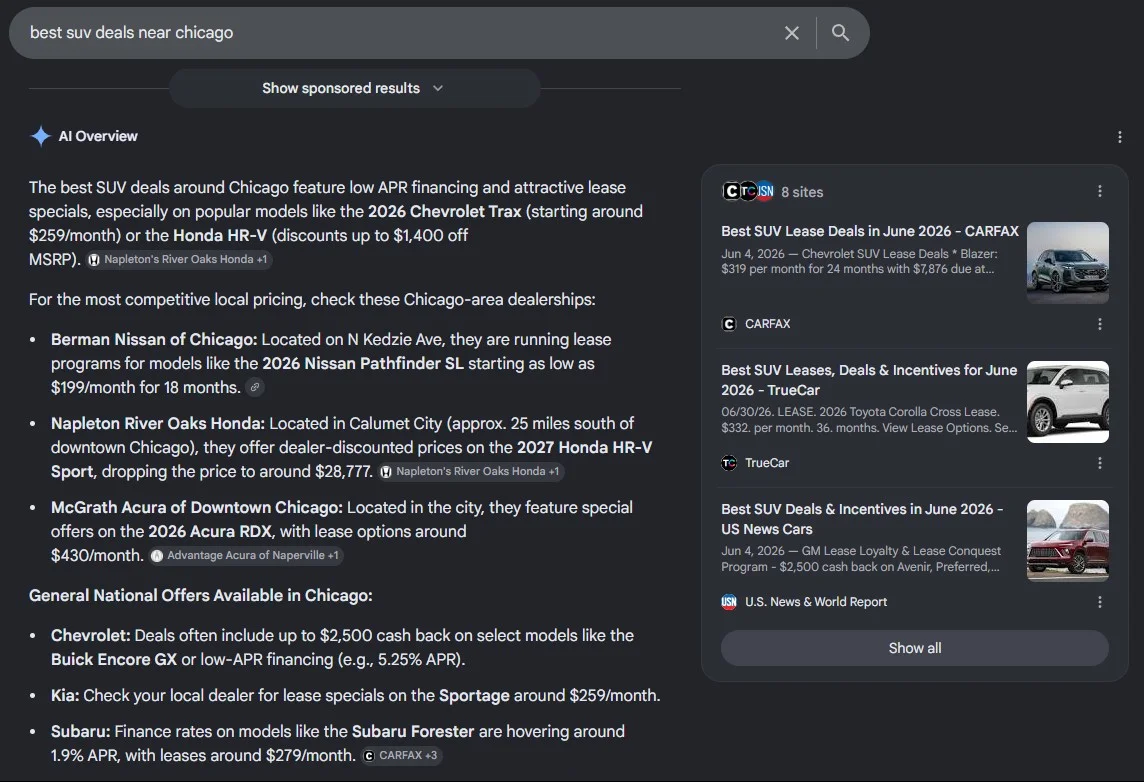
Ask them to pull up, right now, whether the group gets named when a buyer asks an engine for a recommendation. A partner who can't run that check is selling a 2019 playbook. What the check measures, and which engines it has to cover, is AI search visibility work; what changed in the category to make it necessary is set out in automotive SEO trends 2026.
Do they work on top of the platform, or force a switch?
The right answer is on top. A partner who needs a group to leave its platform is solving their own problem.
Who actually does the work?
Ask who writes the content, deploys the schema, and reads the GSC data. If the person selling can't name them, your group is paying for yet another layer of people to work through.
SEO agency red flags
The questions only help if the answers get scored. The SEO agency red flags below show up in the answers rather than in the marketing, which is why they survive a polished pitch. Any one of them is worth a follow-up question. Two or three in the same meeting is usually enough to stop.
- Guaranteed rankings on competitive terms. No vendor owns the ranking algorithm. A pitch built on guaranteed rankings on competitive terms is either aimed at a phrase nobody searches, or it is asking a dealer group to start paying for a promise the vendor has no lever on. Outcomes in this category are expected or targeted, never sold as certainties.
- No number in writing before a discovery call. Most of the category refuses to publish a rate, so this one is common rather than rare, and it still matters. A group that cannot compare prices before the sales process starts is negotiating with no reference point. VulcanAX publishes its rate card at automotive SEO pricing for exactly that reason.
- A platform migration in the first meeting. A partner who needs a group off Dealer.com, DealerOn, or Dealer Inspire before the work can start is solving a vendor problem on the dealer's budget. What a platform genuinely constrains, and what it does not, is covered in dealer platform SEO.
- AI-powered as a capability claim with no method behind it. Ask what gets measured, on which prompts, in which engines, and how often. Vague answers here carry more weight than they would have two years ago, because the category is new enough that most claims about it are still unchecked.
- Reporting that stops at the form fill. Sessions and rankings are inputs. A report that never connects a search session to a lead, and a lead to a sold unit in the DMS, cannot say whether the retainer paid for itself. Ask what the reporting connects to before asking what it looks like.
- Case studies with no rooftop, period, or baseline. A percentage without a starting point is decoration. Ask which store, over which months, measured against what, and whether the same account is still active.
- Nobody in the room does the work. If the person selling cannot name who writes, who deploys, and who reads the data, the group is buying a layer of coordination stacked on top of the labor it thinks it is paying for.
- One report for the whole group. A multi-rooftop program that reports in aggregate hides the store that is losing. Aggregate numbers rise while one rooftop bleeds, and nobody catches it until the general manager calls.
- A contract that keeps the work. Content and schema that live on the vendor's platform leave when the vendor does. Ask, in writing, what stays on the group's domain after a cancellation.
The trade-offs, side by side
The honest read is that no model is universally best. It depends on the gap a group is trying to close, which is why the evaluation starts at the gap rather than at the vendor list. The pricing and value line is where the operator model separates: direct access to the person doing the work, at a rate that doesn't carry a layer of account management.
| Managed platform | Boutique / full-service | Operator | |
|---|---|---|---|
| Real strength | In-CMS fluency, convenience | Breadth, cross-functional content | Speed, ownership, AEO focus |
| Throughput | Low (split across many dealers) | Moderate | High, within scope |
| Layers between dealer and work | Support queue | Account managers | None |
| Pivot speed | Slow | Moderate | On a dime |
| Price to value (speed + access) | Pay for the platform, wait in the queue | Pay for depth and the layers around it | Direct access, no account-management markup |
| Best fit | No AI-search gap | Many workstreams, bigger budget | Groups chasing AI visibility |
Where VulcanAX fits
VulcanAX is the operator model, working on top of whatever platform a group already runs, focused on the gap most partners are slowest to close: getting a group recommended in AI answers and untangling the cannibalization platform-level SEO can't reach. It's the right fit for some groups and the wrong fit for others, and the questions above will tell a group which. What that engagement covers as an automotive SEO practice relationship is set out separately, and cost and tiers stay straight on the comparison page.
FAQ
What questions should you ask an SEO agency?
Eight cover most of it. How would you find and fix two of this group’s rooftops competing for the same query? Can you show today whether the group gets named when a buyer asks an assistant for a recommendation? Do you work on top of the current platform, or require a migration? Who writes the content, deploys the schema, and reads the Search Console data? Which rooftops do you run now? What happens to the content if the contract ends? Does reporting connect to sold units in the DMS? And what is the monthly number, in writing, before a discovery call?
What are red flags when hiring an SEO agency?
Guaranteed rankings on competitive terms, since no vendor owns the ranking algorithm. A refusal to put any number in writing before a discovery call. A pitch that opens with a platform migration. AI-powered as a capability claim with no method attached. Reporting that stops at the form fill instead of sold units in the DMS. Case studies with no rooftop, period, or baseline. A salesperson who cannot name who will do the work. One is worth a question; two or three together usually ends it.
How do you evaluate an automotive SEO agency?
In four passes, in order. Name the gap first, whether that is cannibalization across rooftops, absence from AI answers, or unindexed inventory pages, because the gap decides which model fits. Sort candidates into managed platform, boutique or full-service, and single operator. Run one written brief past all of them and compare the answers rather than the decks. Then score those answers against the red flags. A group that skips the first pass ends up buying whatever the first vendor happened to be selling.
How much should a dealer group pay for SEO?
Automotive SEO pricing varies widely with market competition and content volume, and managed platforms charge a premium for templated output. The number matters less than throughput and who’s doing the work for it.
Does a dealership have to leave Dealer.com or DealerOn to improve SEO?
No. The right partner works on top of the existing platform. A push to migrate solves the vendor’s problem, not the dealer’s.
What's the difference between SEO and AI visibility for a dealership?
SEO earns Google rank. AI visibility earns being named and recommended inside answer engines like ChatGPT. They overlap, the second is newer, and most automotive partners are slow on it.