
AI SEO for car dealerships: getting the store cited when a buyer asks ChatGPT
AI SEO for car dealerships means getting cited inside ChatGPT, Perplexity, and Google AI Overviews, where vehicle buyers now get their answers.
- AI SEO for car dealerships (also sold as AEO or GEO) is the work of getting a store named inside the answer ChatGPT, Perplexity or a Google AI Overview writes back. AI car shopping is a conversation with stages (discovery, comparison, local shortlist, availability, terms), each a separate chance to be named or skipped, and none of it happens on the dealer's site. Jump to section
- An engine pulls three signals: structured vehicle data, consistent review and profile signals, and pages that answer a real buyer question. A store absent from the answer is usually absent from one of those three columns. Jump to section
- What did not change: crawlability, page speed, accurate structured data and consistent business information are still the price of admission. The work that moved sits in a seam neither contract covers by default: schema beyond the template, entity resolution, content authority on the questions buyers put to AI tools, and citation monitoring across engines. Jump to section
- The engines are not interchangeable. AI Overviews, ChatGPT, Perplexity and Gemini assemble answers from different source mixes, so presence has to be checked per engine and a single rank number cannot describe it. Jump to section
- The inventory feed decides more AI outcomes than the content calendar. A real AI SEO effort audits the feed and the vehicle schema before writing an article, and a platform's bolt-on GEO line item (a schema toggle and a new tab) is not the same as AEO built in. Jump to section
A vehicle buyer used to run a search and scan a page of links. Now they ask ChatGPT, Perplexity, or Google's AI Overview a direct question and read the answer it writes back. AI SEO for car dealerships is the work of making a store the source an engine reaches for inside that answer. The dealership either gets named in it or does not exist for that buyer.
AI SEO for dealerships is what the trade also calls AEO or GEO: answer engine optimization, or generative engine optimization. It shares roots with traditional SEO, but the target moved from a ranking position to a citation inside the generated answer.
How buyers use ChatGPT to shop for cars
Buyers use ChatGPT to shop for cars, and how they do it matters more than how many of them do. A buyer describes a situation in plain language instead of typing a keyword. Three rows and a car seat, under four hundred a month, something that holds its value. The engine comes back with models, trade-offs, and, once the question turns local, named stores. By the time that buyer calls a dealership, an engine has already narrowed the field.
AI car shopping runs as a conversation with stages, and every stage is a separate chance for a store to be named or skipped.
| Stage of the conversation | What the buyer asks | What decides whether a store is named |
|---|---|---|
| Discovery | Best three-row SUV for a family of five under $45,000 | Model-level pages with specifics an engine can quote |
| Comparison | Highlander or Telluride for towing a small trailer | Sourced comparisons instead of restated brochure copy |
| Local shortlist | Best Ford dealers near Chicago | Consistent profile data, live reviews, clean local entity signals |
| Availability | Who has a certified Tacoma in stock near me | A current inventory feed the engine can read and attribute |
| Terms | What a buyer should expect to pay for this trim | Pricing and terms stated in text, not locked inside an image |
None of that happens on the dealership's website. It happens in a chat window, and the store's only input is the data it published beforehand. The ordinary search layer keeps running underneath, which is why this work sits on top of car dealership SEO rather than replacing it.
What ChatGPT for car dealerships means on the store side
Most talk about ChatGPT for car dealerships is about internal use: drafting vehicle descriptions, summarizing phone calls, handling routine lead replies. That is a staffing and productivity question. The visibility question runs the other direction, covering what the engine tells a buyer about the store while nobody from the store is in the conversation. A dealership can adopt every AI tool on the market internally and still be missing from every answer in its own market, because internal tooling puts nothing on the page an engine can read.
How an AI engine builds a car-buying answer
An engine does not rank ten pages and hand over the list. It reads the query, pulls from sources it can parse and trust, and composes one answer. For a dealership, the signals it pulls from are specific and mostly technical.
| Signal the engine pulls | What it is | What most dealer sites give it |
|---|---|---|
| Structured vehicle data | Schema describing make, model, trim, price, availability | Unlabeled text an engine has to guess at |
| Review and profile signals | Consistent, current reputation data across sources | Stale listings and mismatched details |
| Question-answering pages | Pages that resolve a real buyer question with specifics | Generic blog posts written for keywords |
The stores that get cited are the ones feeding the engine clean, machine-readable signals. The stores that get skipped are usually invisible for technical reasons that no amount of creative work fixes.
Structured data is the vehicle's native language
An engine reading a vehicle detail page needs to know, without guessing, that a string is a trim and a number is a price. Vehicle schema markup supplies that. When it is missing or malformed, the engine either ignores the page or fills the gap with a competitor's cleaner data. The groundwork is covered in the vehicle schema markup guide for automotive brands.
Traditional SEO and AI SEO are not the same job
Both want the store to be found. They disagree on what "found" means and what earns it.
| Traditional SEO | AI SEO (AEO/GEO) | |
|---|---|---|
| Goal | Rank in the top results | Get cited in the answer |
| Buyer sees | A list of links | One composed answer |
| Wins on | Keywords and backlinks | Structured data and demonstrable authority |
| Scorecard | Position on the results page | Presence inside AI answers |
A store can hold a strong organic position and still be absent from every AI answer in its market. The reverse also happens: a smaller store with cleaner data gets cited above a larger competitor. That reversal is one piece of the broader shift in how dealer groups get found.
What AI search changed about SEO, and what it left alone
How AI is changing SEO shows up first in what a buyer sees. Vehicle research no longer opens on a page of blue links. The first move is a question put to an engine, and the reply comes back already written, assembled from structured data, review signals, and whichever sources the engine weights. Ranking still counts, because ranking is how the engine finds the pages it reads. Being quoted inside the answer is the part that did not exist before, and it is the part most retainers are not built to produce.
What did not change is the entry requirement. Crawlability, page speed, accurate structured data, clean internal linking, and consistent business information across the web are all still required, because an engine has to fetch and parse a page before it can quote one, and it still resolves a store against the same signals Google reads. Those fundamentals were the whole program in 2018. They are now the price of admission, and a program that stops at them is doing real work aimed at a surface fewer buyers ever see.
The work that moved sits in a seam most dealers never look at. The platform owns the template and honors its contract. The retainer owns the content calendar and honors its contract. The decision about whether the store is named in an answer is made by schema beyond the template defaults, entity resolution so the engine can read the store cleanly, content authority on the questions buyers put to AI tools, and citation monitoring across the engines. None of that is inside either contract by default.
The engines are not interchangeable
A dealership's visibility is not uniform across AI surfaces. Each engine assembles answers from a slightly different source mix, so a store can be cited in one and missing from another.
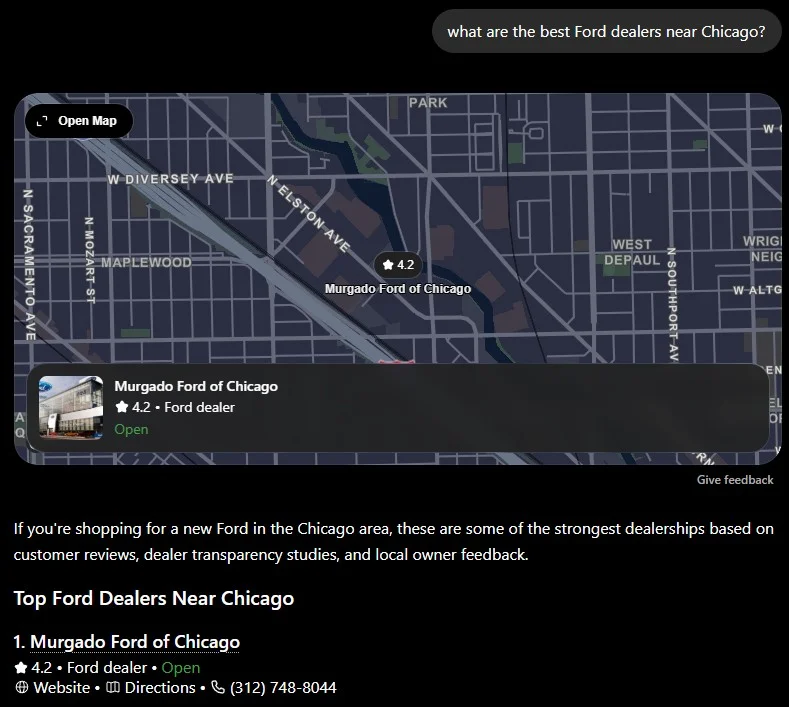
| Engine | How it answers vehicle queries | What earns a citation |
|---|---|---|
| Google AI Overviews | Blends its index with a generated summary | Strong schema plus local relevance |
| ChatGPT with search | Pulls live sources into written prose | Clear, quotable, well-sourced pages |
| Perplexity | Attributes sources inline by default | Machine-readable facts it can cite |
| Gemini | Leans on Google's entity and local data | Consistent profile and inventory signals |
The practical takeaway is that a single rank number cannot describe how a store is doing. Presence has to be checked per engine, because the fix that wins one may not be the fix that wins another.
How AI SEO for dealerships earns a citation
Citation is earned in two places at once: the reputation layer the engine reads for trust, and the content layer it reads for substance.
Reviews and profile signals
Engines treat consistent, current reputation data as a trust signal. A store with matching details across its profiles, fresh reviews, and answered questions reads as a legitimate local answer. A store with conflicting addresses and a dead review profile reads as a risk the engine routes around.
Content that answers instead of fills
The page that gets pulled into an answer resolves a specific question with a specific, sourced fact. The page that gets ignored restates advice a buyer could get anywhere. Volume does not move this. One precise, well-sourced page outperforms fifty generic ones, which is the opposite of what the platform content model is built to produce.
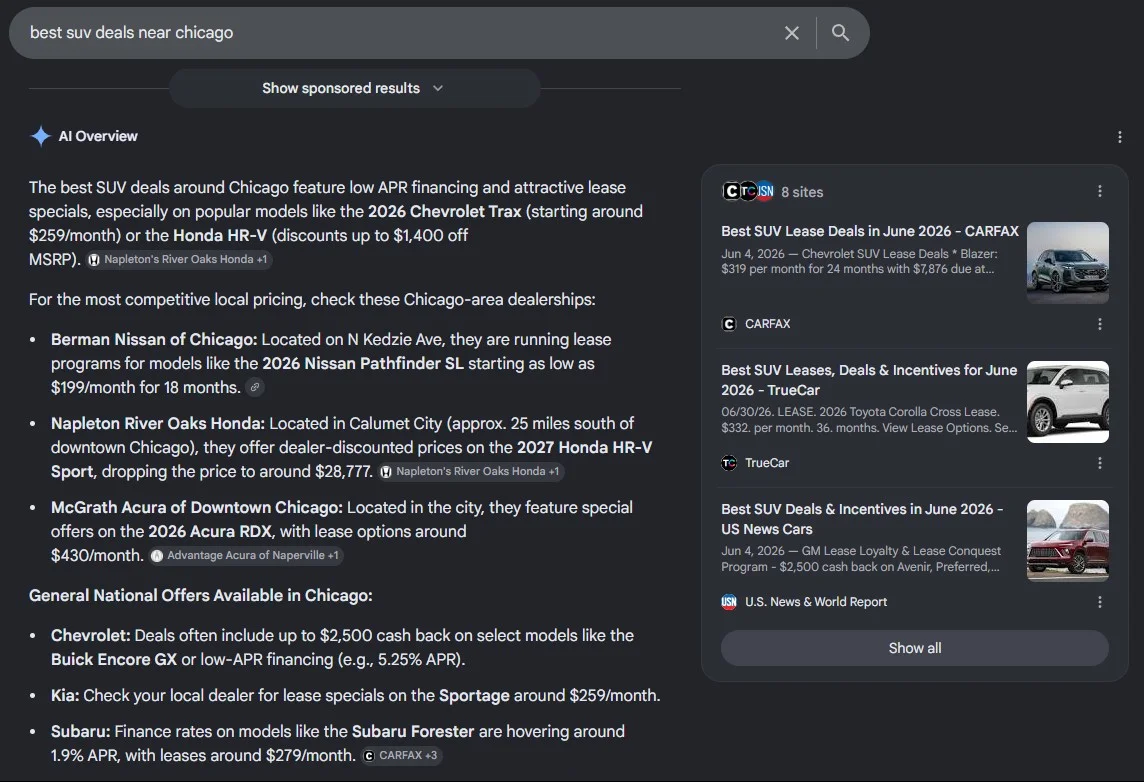
The local profile is a trust signal engines read
Dealers often treat the Google Business Profile as a local-listing chore. In the AI-answer era it is a primary trust signal. Engines cross-reference the profile against the site to confirm a store is a real, active, local business before naming it in an answer. A profile with current hours, accurate departments, answered questions, and a live review stream tells the engine the store is a safe answer. A stale or inconsistent profile undercuts even a well-optimized site.
The mistakes that keep dealers out of AI answers
Most stores are not absent from AI answers because they did too little content. They are absent because of a handful of repeatable errors that block the engine before content ever matters.
| Mistake | Why it blocks citation |
|---|---|
| Vehicle data locked in images or PDFs | The engine cannot read or attribute it |
| Inconsistent details across profiles | The store reads as unreliable |
| Chasing keywords over answering questions | Pages have nothing quotable |
| No measurement of AI presence | The gap is invisible, so it never gets fixed |
None of these are exotic. They are the default state of a dealer site that was set up for the old search model and never adapted, which is exactly the state a scale-built platform tends to leave untouched.
Why managed platforms struggle with this
The platform model runs on scale: one content playbook pushed across hundreds of rooftops. AEO runs on the opposite instinct: the specific schema fix, the one page that answers the one question, the profile cleanup that changes how an engine reads the store. Those two production models do not coexist well inside a single service line. The full account of why that gap exists is in what a managed SEO platform actually delivers.
A bolt-on GEO line item is not the same as AEO built in
Several managed platforms now list generative-engine optimization as an add-on. Most of what ships under that label is a template: a schema toggle and a new tab, stacked on top of a platform fee the store is already paying. That is a checkbox exercise. AEO built in means a store engineered from the schema up, checked engine by engine, with the fix adjusted per engine rather than applied once and left alone, all without an extra platform fee riding on top.
The inventory feed is doing more work than the blog
For a dealership, the asset that decides the most outcomes in AI search is usually the inventory feed, well ahead of the content calendar. When the feed is clean and well-structured, an engine can answer stock, price, and availability questions with the store as the source. When it is messy, the engine answers with an aggregator or a competitor and the store never enters the conversation. This is why a real AI SEO effort audits the feed and the vehicle schema before it writes a single article. The same feed-first order applies outside franchise retail, in powersports and equipment dealer inventory alike.
Measuring whether it is working
Rank tracking cannot see AI citations, so it is the wrong instrument for this work. Presence has to be measured on the surfaces where buyers actually ask, against the signals engines actually read.
| What to track | Why it matters |
|---|---|
| Citations per engine | Shows where the store surfaces and where it is invisible |
| Structured-data ingestion | Confirms the engine can read vehicle and profile data |
| Intent-to-page mapping | Verifies real buyer questions have a page that answers them |
| Profile consistency | Flags mismatches that cost the store trust |
The full discipline of vehicle search analytics, measuring AI search visibility, including how these connect to pipeline, is covered separately.
A dealership can find out where it currently stands in AI answers with an automotive SEO audit rather than a sales call.
FAQ
What is AI SEO for dealerships?
AI SEO for dealerships is the work of getting a store named and cited inside AI-generated answers from ChatGPT, Perplexity, Gemini, and Google AI Overviews, rather than only ranked on a results page. It runs on structured vehicle data, a current inventory feed, consistent profile and review signals, and pages that answer one buyer question with one specific fact.
Do people use ChatGPT to shop for cars?
Yes. Buyers use it the way they once used forums and review sites, describing a budget, a household, and a use case, then asking which models fit and where to buy locally. The pattern matters more than any headline number. A buyer who arrives after that conversation already carries a shortlist, a price expectation, and objections the store never watched form.
How do car dealerships use ChatGPT?
Two separate ways. Internally, stores use it to draft vehicle descriptions, summarize calls, and handle routine lead replies, which is a productivity gain. Externally, ChatGPT decides whether the store gets named when a buyer asks for dealers nearby. The second does not follow from the first. It depends on schema, inventory feed quality, and profile signals the engine can read.
What's the difference between AEO, GEO, and AI SEO?
They describe the same work. AEO (answer engine optimization) and GEO (generative engine optimization) are the industry terms for getting a business cited inside an AI-generated answer rather than only ranked on a results page. AI SEO is the plainer name for the same discipline.
Which parts of SEO did AI not change?
Crawlability, page speed, accurate structured data, clean internal linking, and consistent business information across the web. An engine still has to fetch and parse a page before it can quote one, and it still resolves a dealership against the same signals Google reads. Those fundamentals did not get replaced. They became the entry requirement rather than the whole program.
Which AI engines matter most for a dealership?
Coverage should span Google AI Overviews, ChatGPT with search, Perplexity, and Gemini, because each pulls from a different source mix. A store can be cited in one and absent from another, so presence has to be checked per engine individually, since a single check cannot confirm it everywhere.
Does a dealership need new content to get cited, or is it mostly technical?
Technical first. Clean vehicle schema and an accurate inventory feed decide whether an engine can read the store at all. Content only earns a citation once the engine can parse what it’s looking at. See how the technical layer decides what an engine can read.
How does a dealership know if it's already getting cited?
Rank tracking won’t show it. It has to be checked directly against each engine, alongside structured-data ingestion and review consistency. Measuring AI visibility directly covers what to track instead.