
Automotive search engine optimization, rebuilt for the way buyers actually search
Automotive search engine optimization built for AI answer engines, not last year's ten blue links. How dealer groups get found where buyers actually search.
Automotive search engine optimization used to mean one thing: rank a page in Google's ten blue links and wait for the click. That model is decaying while most dealer retainers keep billing for it.
Vehicle buyers now open ChatGPT, Perplexity, and Google's AI Overviews before they type a dealership name. The answer they act on gets assembled upstream of the results page most SEO work still targets. VulcanAX builds automotive search engine optimization for that shift, and the dealership pays for the work its website actually receives. At single-store level the same discipline goes by car dealership SEO, and the constraints are identical.
What "search" means for a car buyer now
A buyer rarely starts on a dealer site. They ask an engine a question in plain language and take the answer it builds. The engine assembles that answer from structured inventory data, review signals, and pages with real subject authority, not from whatever sits at position four for a keyword.
That is the gap most retainers miss. The store gets optimized for a surface the buyer skips.
| The buyer does this | The engine answers with | The old retainer was optimizing |
|---|---|---|
| Asks "which trim tows the most" | A cited spec page it can parse | A keyword-stuffed blog post |
| Asks "fair price for this model near me" | Structured data and review signals | Blue-link rank on a landing page |
| Asks "who has this color in stock" | A clean inventory feed | A meta description refresh |
A Cox Automotive study of how car buyers research (January 2026, 2,300 buyers) found 25% of new-vehicle buyers used AI tools or AI-generated overviews during their research. A Moz study of roughly 40,000 queries found 88% of Google AI Mode citations don't match a page in the organic top 10. A store can rank and still never appear in the answer a buyer reads.
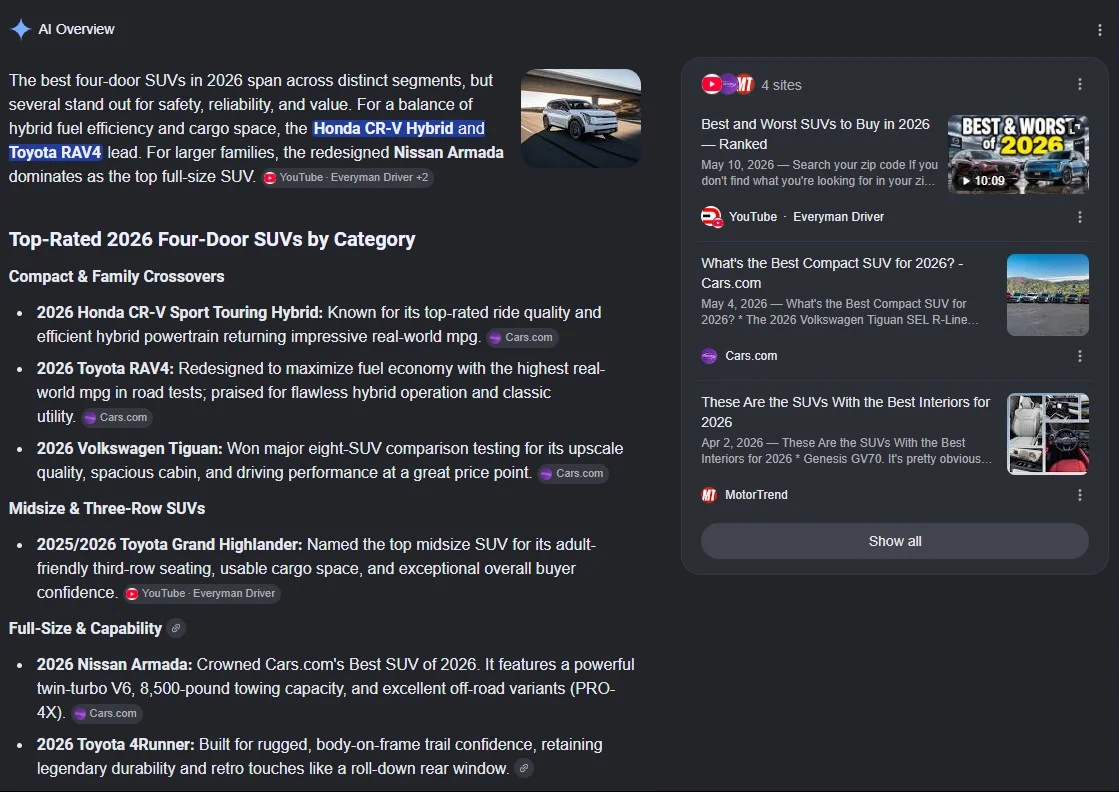
Getting cited, not just ranked
The optimization that moves this is called AEO or GEO (answer engine optimization / generative engine optimization) in the trade: getting the dealership cited inside the answer itself. VulcanAX treats it as the operating reality, not a future add-on. The mechanics of getting a specific store cited by name live in AI SEO for car dealerships.
The retainer most dealers are still paying for
Managed SEO platforms sell a familiar package. Vendors like DealerOn and Dealer Inspire, and the rest of the category, ship templated content, boilerplate meta tags, and a monthly report that trends up regardless of what happens in the store's pipeline.
The pattern shows up in the churn. Groups swap vendors every year to eighteen months, sign the next platform, and watch the same flat result repeat. The problem is rarely the account rep. It is a production model built to service hundreds of rooftops with one playbook, where the deliverable is volume instead of a citation or a crawl fix. The full breakdown is in the managed SEO platform contrast. The way out of the cycle is not the next vendor, it is a sharper vetting process: how to evaluate an SEO agency lays out the three partner models and the questions that expose a weak one before the contract gets signed. The operator alternative to a platform, priced per rooftop and published rather than quoted on a call, is set out on the automotive SEO agency page.
What automotive search engine optimization actually requires
Real gains come from a few things done with judgment, not from content volume. Three layers carry the work, and the lower layer always bounds what the layer above it can achieve.
| Layer | What it decides | Covered in |
|---|---|---|
| Technical | Whether an engine can read the site at all: feeds, VDP/SRP (vehicle detail / search results pages) templates, schema, indexation, Core Web Vitals | Technical SEO and vehicle schema markup |
| Authority | Whether the engine trusts and cites the site: question-answering pages, machine-readable structured data, review signals | AI SEO for car dealerships |
| Measurement | Whether any of it is working: AI-answer presence, ingestion checks, intent-to-page mapping | Vehicle search analytics |
Why the technical layer comes first
A store with 73 of 75 vehicle detail pages sharing an identical title pattern is invisible to the engine, no matter how much content sits on top. Fixing the crawl and schema layer often unblocks a hundred pages at once, which is why it runs ahead of any content push.
Why volume stopped working
A page that restates generic advice gets ignored. A page that answers a precise buyer question with a linked, verifiable source gets pulled into the answer. The scorecard moved with it: blue-link rank no longer tells a store whether it is winning, and measurement now tracks whether the site surfaces in AI answers at all.
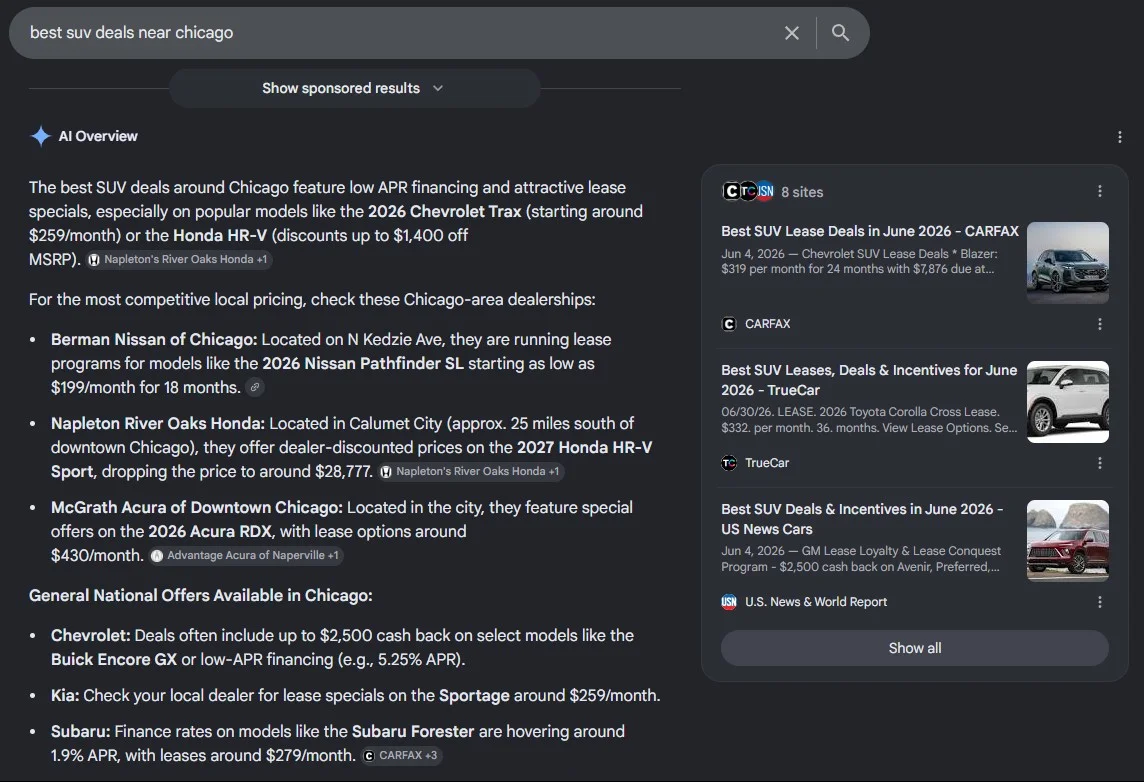
Matching each query class to the page that should own it
Most dealer sites answer every kind of query with the same three page types: the homepage, an inventory grid, and a thin location page. Buyer intent is wider than that. Each class of question has one page that should own it, and when two pages half-answer the same question, they split the signal and neither earns the answer. The same thing happens at group scale when two rooftops publish near-identical pages against one query.
| Query class | What it sounds like | The page that should own it |
|---|---|---|
| Model research | "hybrid SUVs with three rows" | A spec-accurate model or comparison page |
| Local dealer choice | "best Ford dealer near me for a lease" | A store page with consistent data, backed by the Google Business Profile |
| Inventory | "blue hybrid Maverick in stock near me" | A clean, current vehicle detail page |
| Ownership and service | "how often does a diesel need service" | A service page that answers the question plainly |
| Finance and trade-in | "can I trade in a leased car early" | A finance page with real terms, not boilerplate |
This map is where cannibalization work becomes concrete. Most of it is consolidation rather than new writing: find the queries where a site competes against itself, give the strongest page the job, and retire or redirect the rest. On a multi-rooftop group, the same audit runs across domains, because the engine sees the group's stores as competing sources even when the group sees them as one business.
Local search still decides the sale
Even in an AI-answer world, most vehicle purchases resolve locally, and the engine knows it. When a buyer asks a question with local intent, the engine weighs proximity, profile consistency, and reputation before it names a store. A dealer group with mismatched addresses across profiles, a neglected Google Business Profile, or a dead review stream reads as a risk the engine routes around, no matter how strong the main site is.
This is why local signal hygiene sits alongside technical and content work rather than beneath it. A clean, current profile is often the difference between being the named answer and being the store the buyer never hears about.
Google's own Business Profile guidance names three factors behind local ranking: relevance, distance, and prominence. Distance is fixed. The other two are workable: complete, accurate profile data feeds relevance, and a live review stream with real responses feeds prominence. That same profile data is what an answer engine has in hand when it decides which stores to name for a local question, which makes profile upkeep part of the same discipline rather than a separate errand.
Content that earns a citation, not content that fills a calendar
The automotive content most retainers ship is built to hit a monthly quota. It restates advice a buyer could find anywhere, and an engine has no reason to cite it. The content that gets pulled into an answer does the opposite: it resolves one real buyer question with a specific, verifiable fact, and it does so on a page an engine can read cleanly.
That difference reframes the whole content question. The goal is not more posts. It is fewer, sharper pages that each earn their place by answering something a buyer actually asked. A dealer publishing a genuinely useful guide to a model's towing configuration will out-cite a competitor pushing four generic posts a week, because only one of them gave the engine something worth quoting.
The order automotive search engine optimization work runs in
The sequence matters as much as the task list, because each layer bounds the one above it. The crawl and schema work runs first: until an engine can read the site cleanly, nothing published on top of it registers. Google's crawl-budget guidance is written for exactly the kind of site a dealer group runs, thousands of URLs with daily inventory churn, and it names the failure modes that soak up crawl attention: duplicate URLs, soft 404s, and long redirect chains.
The cannibalization map comes second, built from twelve months of GSC (Google Search Console) data, because it determines which pages the content work should strengthen and which should be consolidated away. Content runs third, page by page against the intent map above. Measurement runs from the first week rather than the last: a baseline of where the group appears in AI answers before anything changes, so every later check is against a recorded starting point instead of a memory.
Why one operator beats the platform on this problem
The platform model optimizes for scale. AEO work optimizes for specificity: the citation, the schema detail, the one fix that unblocks the crawl. Those goals pull against each other, and a line built to push templated content across a client base cannot also do the per-site judgment work.
| Platform model | VulcanAX | |
|---|---|---|
| Built to | Service hundreds of rooftops | Do the work on one site |
| You pay for | Content volume | Output traced to a page and a result |
| Pricing | Hidden behind a discovery call | Shown on the site |
| Focus | This month's report | Getting the store cited |
Different dealer types need different versions of this, from powersports shops, golf cart dealers, and generator and equipment dealers to vehicle graphics companies, classic and exotic car businesses, and multi-rooftop groups, but the principle holds. The fix is not more content. It is the right work, done where the buyer is actually looking.
Groups weighing the operator model against an agency or a platform can compare the options by name in the roster of automotive SEO companies.
Those three layers are delivered as six services under one operator. What each one covers, and what sits inside each per-rooftop tier, is published on the automotive SEO services page.
A group that wants to see where its own site stands in AI search can start with an audit instead of a pitch.
FAQ
What is automotive search engine optimization?
Automotive search engine optimization is the work of making a vehicle business findable and citable across the surfaces buyers use: organic results, the Google local pack, and AI-generated answers. It runs on three layers. The technical layer decides whether an engine can read the site at all. The content layer decides whether the site has anything worth citing. The measurement layer checks whether an engine actually names the store.
Is automotive search engine optimization different from AI SEO?
They’re the same underlying discipline at different depths. Automotive SEO is the full stack: technical, content, and measurement. AI SEO for dealerships is the sharpest current expression of it, getting a store cited inside ChatGPT, Perplexity, and Google AI Overviews rather than only ranked.
How much does automotive search engine optimization cost?
VulcanAX publishes flat per-rooftop rates starting at $1,165 per month, month to month, with banded volume discounts up to 32% for larger groups. Most vendors in the category keep pricing behind a discovery call instead. The full rate card sits on the pricing page, and the market ranges other vendors quote are broken down in what is automotive SEO.
Where should a dealer group start with automotive search engine optimization?
With the crawl and schema layer, then a cannibalization map built from twelve months of Search Console data, then content written against the intent map. Measurement runs from the first week so every later check compares against a recorded baseline rather than a memory. Starting with content on a site an engine cannot read cleanly is the most common way a retainer produces nothing.
Do dealerships still need to care about Google rank?
Yes. Most vehicle purchases still resolve locally, and local pack position and Google Business Profile health remain real inputs to whether an engine names a store at all. Rank isn’t obsolete, it’s just no longer the whole scorecard.
How is this different from what a managed SEO platform sells?
A managed platform is built to service hundreds of rooftops with one playbook. This work is built for one site at a time: the specific schema fix, the specific crawl error, the specific page that earns a citation. The full contrast is in what a managed SEO platform actually delivers.
How does a dealer group find out if it's actually showing up in AI answers?
Run the buyer’s real questions across the major engines for the relevant market, or get a baseline built. Contact VulcanAX for a free audit.