
Vehicle search analytics: measuring visibility the rank report can't see
Why rank tracking is blind to AI citations, and what to measure instead to see real visibility.
A dealer looking at a rank report in 2026 is reading an instrument built for a search era that is fading. The report can show position five for a keyword and say nothing about whether the store appears in the AI answer a buyer actually reads. Vehicle search analytics closes that blind spot by measuring the surfaces and signals that now decide visibility.
The shift is not about collecting more data. It is about measuring the right things, because the old scorecard now hides more than it shows.
Why rank tracking went blind
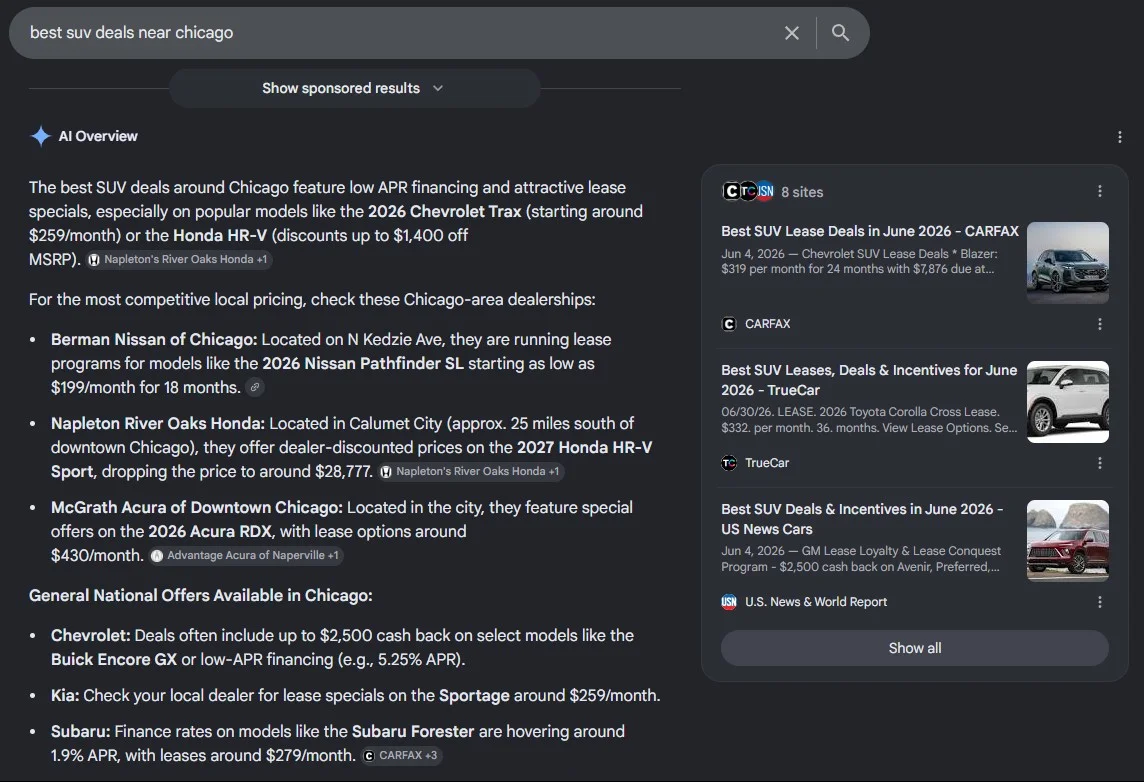
Rank tracking assumes a buyer sees a list of links and picks one. Increasingly the buyer sees a single composed answer and never scrolls a results page. A position that once predicted traffic no longer does.
| Old metric | What it assumed | Why it misleads now |
|---|---|---|
| Keyword rank | Buyer scans the list | Buyer reads one AI answer |
| Organic clicks | Rank drives visits | AI answers resolve without a click |
| Impressions | More is better | Impressions with zero clicks signal an answer-layer gap |
That last row is the common trap. A store can rack up impressions and no clicks, which usually means the engine is showing the query but citing someone else in the answer.
What to measure instead
Useful vehicle search analytics track presence where buyers ask and the signals engines read, then connect both to the store's pipeline.
| Metric | What it tells the store |
|---|---|
| AI citations per engine | Whether the store surfaces in answers, and where it is absent |
| Structured-data ingestion | Whether engines can actually read vehicle and profile data |
| Intent-to-page coverage | Whether real buyer questions have a page that answers them |
| Impression-to-citation gap | Where the store is seen but not chosen |
| Local pack and profile health | Whether proximity and reputation signals hold up |
These measure cause, not just effect. When a number moves, it points to a specific fix rather than a vague trend, the kind of fix covered directly in AI SEO for car dealerships.
Reading the impression-to-citation gap
The most telling number in the AI era is the one most dealers overlook: impressions with no clicks. A store can accumulate impressions on a keyword and see zero clicks, and the instinct is to read that as low ranking. Often it means something sharper. The engine is showing the query and building an answer that cites someone else, so the store is seen by the algorithm and skipped by the buyer.
That gap is a diagnostic, not a dead end. A wall of impressions with no clicks points straight at the authority layer: the store is in consideration but is not the source the engine trusts to answer. Closing it is a content-and-structured-data problem, not a bid or a budget problem, and it is invisible to anyone still reading a rank report.
Connecting analytics to the actual pipeline
Measurement earns its place only when it links to units and revenue. A citation that never influences a buyer is vanity. Real vehicle search analytics trace the path from an AI answer or search surface to a site visit to a lead, so the store can tell which visibility actually produces business. This is the discipline a scale-built reporting dashboard skips, for the reasons covered in the managed SEO platform contrast, where activity gets reported in place of outcomes.
What honest reporting looks like
A report that only trends activity upward is built to reassure, not to inform. A useful vehicle-search report is legible to the person paying for it and ties every number to a decision. It shows where the store is cited and where it is absent, what changed since last month and why, and which specific work comes next as a result. If a report cannot survive the question "what did this produce," it is measuring the wrong thing.
Reporting cadence should match how the signal moves
Some vendors now sell a daily or weekly AI-rank dashboard as a premium feature. AI-citation and answer-engine signals do not move on a daily clock, so a dashboard that refreshes every day is charting noise. A report updating faster than the underlying signal is theater: motion on the screen standing in for information the store can act on. The useful cadence tracks how the data actually shifts rather than how busy the dashboard looks in a sales demo.
Measurement drives the work, not the other way around
Good analytics are not a monthly formality. They decide what gets worked on next: a large impression-to-citation gap points to the authority layer, a schema-ingestion failure points to the technical layer in technical SEO for automotive brands, and a coverage gap points to a missing page. The measurement and the strategy in automotive search engine optimization are one loop, not two functions.
A dealer or automotive business can get a clear read on its true search visibility with an analytics-driven audit.
FAQ
Straight answers to the questions this topic raises most.
Why can't rank tracking see AI citations?
Rank trackers were built to measure position on a results page. AI answers are composed, not ranked, so a store can be cited inside an answer with no results-page position to track at all.
What does a high-impression, zero-click keyword usually mean?
Often that the engine is showing the query and building an answer that cites a competitor instead. It’s a signal the store is in consideration but isn’t the source the engine trusts, which points at the authority layer, not a bid or budget problem.
How do you tie AI-search visibility back to actual leads?
By tracing the path from an AI answer or search surface to a site visit to a lead, the same way any channel should be measured. A citation that never influences a buyer is vanity, not a result.
What does a report that's actually useful look like?
One that’s legible to the person paying for it: where the store is cited, where it’s absent, what changed since last month and why, and what specific work comes next as a result.